Thursday, January 25, 2018

The Magic and Science of Walking (Part 5)


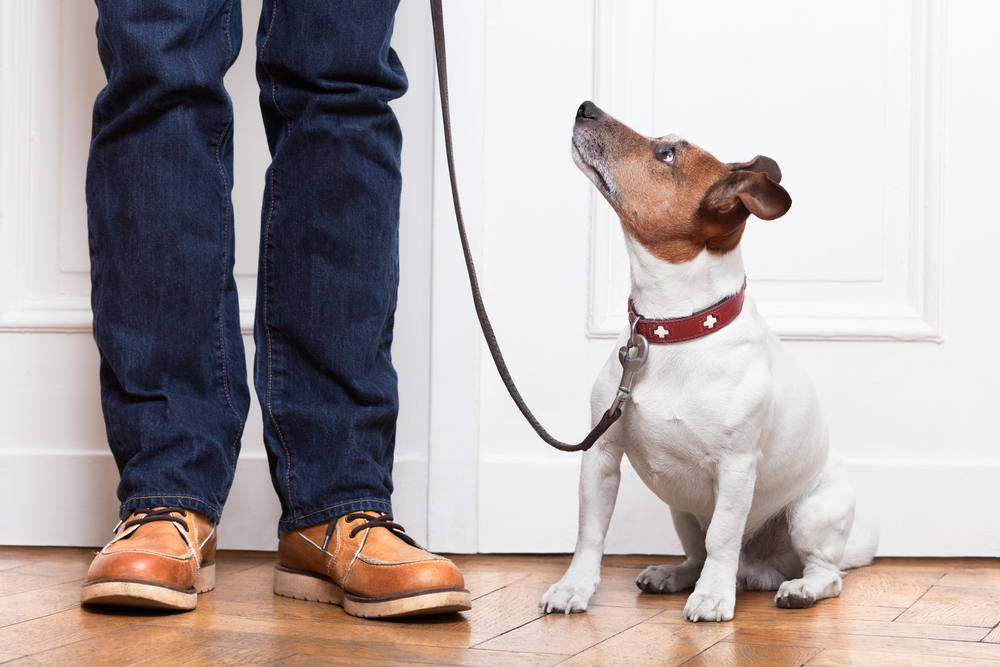
So here we are, outside. The door is shut behind us and this very good dog is sitting and waiting for the walk to begin. Are you ready? Make sure you have his attention by saying his name so that he looks at you. Use a command that let's him know it's time to move. "Heel" is traditional, but I use a simple "Let's go!" Then step off and we're walking!

Keeping your dog close is a good idea; he's easier to manage and control, and it reinforces in the dog's mind the idea that you are a team, together. Eyes ahead, you maintain a brisk, steady pace -- don't hurry, but keep a definite "we're going this way, adventure ahoy!" attitude. No stopping to sniff things, no dawdling; you're on a big important walk and here we go. It's all about you, human person, and you decide where to go and how fast. You are the decision-maker. 

Now this might be exciting for your dog, and he is probably going to fall into his old habit of charging ahead. That's not how it goes anymore, though, so you have to let him know that there's a better way. Stop, and tell him to sit. 

Image result for dog walk

Look at that! Good dog! Wait for a second or two, then get his attention and let him know what to do:"Sparky. Let's go!" and walk on. 

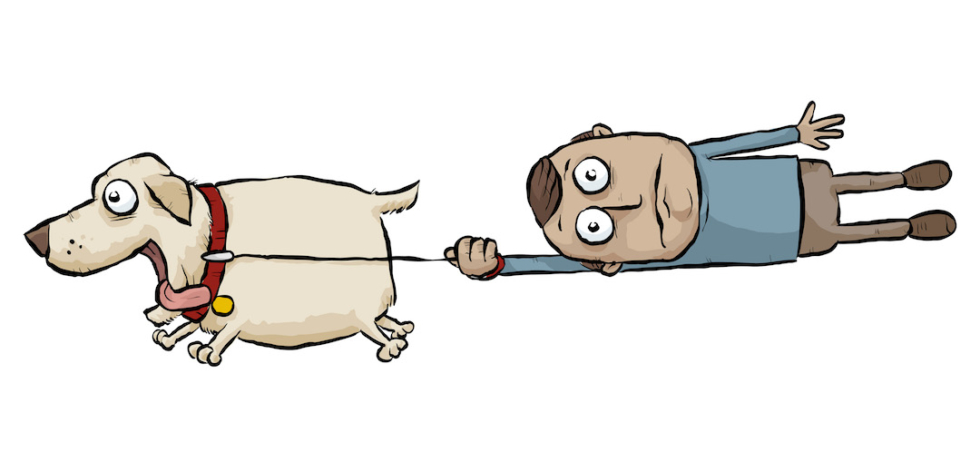
Oh wait. You say he didn't sit? He's still pulling? 

Image result for dog walk pulling

He's not listening to you. You aren't interesting enough. Remind him that you're there by giving a check on the leash -- a short sharp tug. Do it twice, and if he still isn't listening, then back him up. Walk backwards yourself, and keep checking the leash as you go back: tug, tug, tug. Make a disagreeable sound like "Nah, nah, nah!" to let the dog know you're not happy. 

Notice I'm not saying to pull the dog. A long, steady pull gives the dog something to lean against and resist. The uneven tug and release of checking gives him nothing to fight against -- if he tries to lean, he'll lose his balance. He has to keep moving and readjusting himself. It's uncomfortable for him. 

Back him up three or four strides and ask him to sit again. No sit? Keep backing. I once backed a dog up half a block before he decided that it was easier to just do as I asked.  

What you want to do is make it easy and pleasant to do the right thing, and make doing the wrong thing difficult and unpleasant. Dogs are like anyone else-- they want to be comfortable. Once your dog figures out that walking nicely is comfortable and anything else is no fun, he'll make the right choice. 

Once you get that sit, you can cheerfully continue the walk. Get used to mood swings like this when training. Help your dog recognize what makes you happy and what doesn't as he does it. It's no use debriefing him afterwards ("Now Charley, you did great at first, but then you tried to chase that cat and so next time we need to...") Dogs live very much in the moment, so praise or correct right away. 

As you walk, keep the leash short but not tight. Your dog will learn that he can be comfortable walking close to you, but if he moves away he gets checked. 
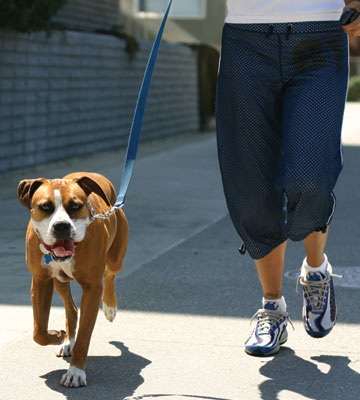

Image result for dog walk
This leash has the perfect amount of slack. 
(Kindly ignore that wretched chain collar. It's very hard to find pictures of dogs and people walking nicely together and I gotta use what I can.)

If you hold your dog close to you on a tight leash, he will be where he's meant to be, but he's not learning to stay there on his own. As soon as you release the tension on the leash, he'll feel the freedom and take off. It doesn't teach him anything and it's a lot of work for you. So let there be a looseness in the leash and give him a check if he starts to move too far away. (This is one of the reasons I hate extendable leashes -- they keep a constant tension, so your dog never learns where he can be comfortable.)

This takes timing and practice, and at the beginning you'll feel like you're nagging that poor dog to death. All beginnings are hard. You'll get it. In the meantime, think of it as you and your dog having a little conversation about figuring stuff out. He's learning, too. 

 Okay, there's some stuff to work on. Go for a walk! I'll see you next time.

A Brief Interlude to Talk About "Checks"

I use the word "check" a lot, so I want to make sure we're clear on what I mean.

A "check" is a quick tug and release on the leash. Some other terms used by trainers are snap, pop, jerk, or correction. It takes an instant and is over, like a poke or a sneeze.

It is not meant to move the dog by dragging, or choke the dog. It's meant to get his attention back onto you so he's ready and listening when you give a command. It's meant to caution and redirect him if he isn't where he's meant to be.

I found a quick video, since the one I made doesn't want to load. I don't know who this person is, but she's demonstrates a nice leash check.


(After the short video plays, there's more in line after it that are full of silly gimmicks and "training tools" that you do not need to pay any attention to at all, ridiculous stuff.)  

Which leads me into a talk about the amount of force to put into it. You will have to figure this out yourself, because every dog is different. Some are delicate little flowers who get nervous or worried at the slightest touch, and some are hard-headed linebackers.  And it's nothing to do with size or breed -- I walk a 75-pound pitbull that worries if I so much as clear my throat, he's so willing to please, and I also walk a 10-pound chihuahua-terrier mix that I could wallop with a hockey stick and she'd not back down.

I will say this: use as much as necessary, but as little as possible. If your dog ignores you, you need to use a little more pressure. If he cowers or cries out, you're too rough. Try it first in a safe place, at home, where there are no distractions. Just put the leash on and wait, then give a little tug when your dog isn't expecting it. See what it takes to make him turn and look at you; "What's up?" And be sure to tell him what a fine and lovely pup he is for that. Every time he looks at you to see what you want, he's being the best dog ever, and you reward him by being kind and showing him what a nice person you are. Make him want to pay attention.

After the first few times, you might discover that you don't need to use as much force. Your dog has realized that the check on the leash means something, and he's more responsive. You can lighten up, congratulations!  Or maybe your dog is testing you to see if you really mean it and he decides to ignore your check on the leash. Get after him with a second, more stern check to let him know he must listen to you.

Okay, now back to dog walking.

Tuesday, January 16, 2018

The Magic and Science of Walking (Part 4)

So what does all this sitting have to do with walking? A lot, actually! 

It puts your dog in a position where he's looking up at you, ready for whatever you do next.

It opens communication between the two of you. You have one sound that you both know the meaning of.

It lets your dog know that when you make sounds, he should pay attention or he might miss out on something. Will you make other sounds that might pay off with more treats? What an exciting person you are!

It makes it very easy to put on the leash when your dog is sitting, rather than prancing around excitedly.

So get that leash and let's get walking!

Image result for dog pulling on leash

 Oh dear.

Let me back up a little bit.

Your dog is much too excited to listen to you at the beginning of a walk. He's probably been laying around for a good while and is bored, restless, and full of energy. Trying to teach your dog not to pull when he's like this will be frustrating for you both. Burn off some of that rocket fuel first! If you have a yard, go outside and play for a while, doing something your dog enjoys like playing fetch. If you don't have a yard, play inside. One of my tricks is tossing a favorite toy up the stairs, which gives the dog a good workout running up and down, (though this can be hard on the joints so be mindful of puppies or senior dogs). Fifteen minutes to half an hour of off-leash chasing and scampering will take the edge off and make your dog more willing to slow down.

When it's time to put on the leash, don't get your dog jazzed up by saying "Wanna go for a walk? Oh boy! Let's get your leash! Hooray!" and so on. That's just adding fuel to the fire. Be calm and quiet. After the leash is on, have your dog remain sitting while you put on your coat, get your house key, check your phone, or whatever. Just a minute or two will help him get the idea to relax.

Then, taking the leash in both hands (need a refresher on that grip? It's here.) and keeping your dog close, open the door and step outside.

Have him sit while you close the door. Did you bring treats? Now it the perfect time to treat, after he sits.

Image result for dog on leash sitting by door

What if he didn't sit? What if he's dancing around like a fool, jumping and straining and pulling? Then you drag him back into the house, shut the door firmly on the fun outdoors, and ask him again to SIT. Use a strong tone, but don't shout. Say it once and wait. If he's not paying attention then give a check on the leash -- a quick jerk just strong enough to get his attention back on you where it belongs. It's not a punishment; we're not trying to hurt him, but we need to be firm and let him know that this behavior is not acceptable and we'd like him to do something else: SIT.

If he sits, let him know he did right by saying "good" or "thank you" -- mild praise. Then open the door and try again.

We want him to step outside, then sit and wait for you to say it's okay to go on. If you take him out again and he shows no improvement, then take him inside, take off the leash, and do something else, ignoring him. No fun outside walk for him.  Don't scold. Don't yell. Don't explain like he could understand. You're not giving any attention to a bad dog who doesn't listen to you. Bad, not-listening dogs don't get the treat of a walk. Bad, not-listening dogs can just sit inside and think about how that certainly did not go the way they thought it would.

Image result for dog frowning

And believe me, your dog will be wondering what the heck THAT was all about. Let him stew over it for about ten minutes. Just ignore him. Go polish your shoes or put in some laundry or unload the dishwasher. You're a busy person; got no time for a bad, not-listening dog to drag you around, no sir.

Ten minutes up? Call your dog to you, have him sit, put on the leash, let him relax for that minute or two, and then try again: out the door and sit.

Is he listening better this time?

You may have to repeat this a few times; your dog is learning a few things and he might not get it right away. He's learning that you are in control and the way to get what he wants is to do what you want. Just like he learned that to get a treat, he must sit, he will learn that in order to go on a walk, he must sit when asked.

If he sits, he gets to go forward. Refusal to sit means he doesn't get to go on the walk.

Once your dog is sitting nicely and waiting while you shut the door, Congratulations! You're ready for part five.


Monday, December 18, 2017

The Magic and Science of Walking (Part 3)


Why do we teach a dog to sit?

It's kind of a weird trick, on its own, and isn't particularly amazing. It's more of a polite request to be more comfortable. Won't you have a seat? And yet it seems to be the most common thing people say to a dog besides its name. 

But "sit" is secretly wonderful. It's a posture the dog takes naturally, and it places him in the perfect position: looking up. And what's he looking at? You! Well, you and that treat in your hand, maybe. Still, his attention is on you, and that's exactly where you want it. 


There's my baby Josie, only two months old and sitting like a champ: ears forward, eyes on me, wondering what exciting thing we're going to do next. 

And it's easy to teach this to your dog, especially when he's a pup. Show him the treat, say the word SIT, and slowly move the treat up and over his head. He'll follow it with his eyes, and as he shifts his weight back, his puppy butt will go into a sit. Treat immediately and praise praise praise. Take a step back yourself so he gets up to follow you, and say SIT again. 

Run through this three to five times and when you think he's got it, ask him to SIT and then just wait for him to do it -- You don't move, no talking, keep still.

He may sit right down like an old pro. So smart! 

He may wonder why you're not flying that treat over his head this time. Give him a moment to think about it. Let him run through some experiments: jumping, sniffing around, barking. He's trying to figure out what will get that treat from you. Say it once more SIT -- but only once. Then just wait. 

If he doesn't seem to understand, go back to guiding him with the treat a few more times. 

There will be a magic moment when you say SIT and he does, right away. Treat immediately, big praise and then go do something else. Get a toy and play, or go outside -- keep playing with your pup, but training is over.  

Your dog has learned:

1. You say a word that means something.

2. If he does the thing, he gets a treat.

3. Then more fun things! 

But why stop just when he's getting it? Because you want to keep it interesting and fun. He's just discovered that of all the sounds you make, there's one that he understands! Just think of how magical that is. 

Later on, you can try it again. And once he's got it, then this happens: 

SIT is how the proper dog says "Please". 

You want the treat? Sit. 
You want the door opened? Sit. 
You want me to throw the ball? Sit.
You want up on the couch? Sit. 
You want your dinner? Sit.

Every single thing your dog wants from you is a reward he earns by saying please -- sitting. And he will be so excited to show off! You might start to notice times when your dog will ask for things on his own -- like dropping a toy at your feet and then sitting. He's politely inviting you to play! 

But what on earth does sitting have to do with walking? 

Oh, I'll get to that next time! 

Thursday, November 30, 2017

The Magic and Science of Walking (Part Two)

Dogs are very good at training humans, have you noticed that? Here's a scenario:

Tyler comes home from work and he's exhausted. He gets a cold beer from the fridge and opens the door to the back patio. His dog Sport goes outside with him. Tyler sits back in a deck chair. He wants to drink his beer and relax. Sport is sniffing around taking care of dog business. The neighbor is mowing the lawn. It's a nice sunny afternoon. Tyler takes another swig of beer and sighs happily, closing his eyes.

Then he feels hot breath on his face. He looks, and there's Sport by his side. Tyler pats Sport and smiles. Sport picks up a muddy tennis ball and looks hopefully at Tyler. How about a game of fetch? Tyler shakes his head. "Sorry pal, I'm beat. I just want to sit for a bit."

Sport drops the muddy ball in Tyler's lap and wags his tail.

Tyler drops the ball beside his chair. "Not now, Sport. Maybe later."

Sport barks. He's got a really loud bark, that dog. And it's piercing and insistent. ARF ARF ARF!

Tyler sighs, picks up the ball, and throws it. Sport chases after it. Hooray!


Image result for dog with ball


Here's another scenario:

Janine and her friend Kate are sitting in the living room talking about the movie they're going to see that night. Janine's dog Teeka comes in and jumps up on the couch next to her. Janine moves over so Teeka can have more room.


Image result for dog women on couch

See how well those dogs have trained their humans? Tyler said no at first but Sport insisted and eventually Tyler did what Sport asked.  And Teeka has Janine so well trained that Janine didn't hesitate at all before making room for her.

Can you think of any tricks your dog has trained you to do?

Humans are pretty agreeable, generally. Moving over to make space for a friend to sit is normal behavior for us. And we're smart. We can understand that barking dog wants us to play. So it's reasonable that we take these steps that make it easier to exist alongside our pets.

Now think about this: how often do you ask your dog to pay attention to you?

I'm not asking how much time you spend with your dog. I'm asking about intent. When he comes over with a ball or pushes his head into your lap to get petted, he's getting your attention. When he chews on a shoe or chases the cat and you scold him, he's getting your attention. How often do you ask him to pay attention to you?

When you call him in from the yard, how many times do you have to call him before he responds? 

When you ask him to sit, how many times do you ask before he does it? Does he look to see if you have a treat first? Dogs have sure got us bamboozled!

Let's get that dog's attention! It all starts with the most basic trick in the world: sit.

So that's the next step: Get your dog's attention with the magic of SIT.

That's it for now. Spend the next few days noticing how your dog has you trained and I'll be back soon with Part 3. 

Thursday, November 9, 2017

The Magic and Science of Walking. (Part One)

I walk a lot of dogs every day. In fact, I estimate I've done over 35,000 dog walks since I started this business. In that time, I've managed to learn a few things: how to keep dry walking all day in a downpour; how to get a pill into a struggling shih-tzu without getting bitten; how far I can drive on a gas tank pointing to "E". But the one thing I've learned that serves me best is how to get a dog to walk nicely on leash.

It's one of my main dog rules: Don't pull me down the street. I don't want to come home at night with my arms longer than when I left home in the morning. 

And everyone seems so delighted and surprised when I do it. "Rover never behaves that well for me!" they gasp in wonder. One client showed me her entryway closet full of collars, harnesses, leashes, and gadgets and said "Use whatever you like. She pulls like crazy. Just try to control her the best you can. I'm sorry." 

So today, because I'm feeling generous, I'm going to talk about how I get my dogs to behave so nicely. Are you ready for this? 

I ask them to.

That's it, really. 

No, I'm not kidding. 

Meet Lisa and Curly, an imaginary woman and dog I've chosen to illustrate by this typical photo I found with a Google search. Lisa wants to go for a walk with Curly, so she's got Curly in a sensible flat buckle collar attached to a basic leash; all ready for a nice walk outdoors. 

Then they step outside, and...

Image result for dog crazy on leash

Ugh, Lisa says, as she scrambles after her dog. Why is Curly like this? I hate this!

Curly doesn't have any idea this is wrong. Curly thinks this is what a walk is -- walks have always been like this for him. Sure, it's a little uncomfortable, with Lisa dragging behind him and he probably wishes she could run faster, but he gets to sniff all the good things, chase after squirrels and bicycles, and pee on things.

Lisa is miserable, of course, and I don't have to explain her feelings, because if you have a dog like this, you already know.  

Curly doesn't know that Lisa is unhappy. She's behind him yelling "Curly! Curly! Slow down! Stop it! Curly!" But she always does that, and Curly doesn't speak English so to him it's just exciting noise that adds to the fun. 
Lisa needs to ask Curly to do things differently. 

Remember a few posts back I talked about how to hold a leash? (If you don't remember, take a look now. I'll wait.)  Lisa needs to hold the leash using both hands. Why is this important? Because it gives her an advantage and it's SCIENCE. 

Newton -- yeah, the apple on the head guy-- tells us that the amount of gravity something possesses is proportional to its mass and distance between it and another object. In other words, when Lisa lets Curly have all that length of leash, she's increasing the amount of "pull" he can put on her. Curly can hit the end of that long leash with a pretty substantial amount of force. When Lisa shortens the leash and brings Curly closer to her, he is easier to control.

Teach Your Dog Not to Pull on Leash | Victoria Stilwell Positively

Look at this picture, at that short length of leash the dog has. He's being kept right by his walker's side, where he should be. He can still sniff and explore and relieve himself. He's not getting underfoot or tangled, and he can't use his weight to increase his forward momentum with as much force. 

That's the first step: Both hands. Shorten the leash. Keep your dog close.

Now I'm gonna go have some lunch and then walk some more dogs. Stay tuned for the next part!

Friday, October 24, 2014

Knock Knock -- who's there?

Halloween is coming up, you guys, with spooky fun for all ages, and candy and trick-or-treating and costumes and -- think about how weird that has to look to your dog. Not only is the doorbell going crazy ever two minutes  (ARF ARF ARF ARF!) but when it's opened -- what the heck, who is THAT? 


Masks? Brooms? Pirate swords? And then they holler "Trick or Treat!!" It's enough to make any dog a little nervous. 

Halloween can be a challenging time to be a good dog. 

Some dogs seem to figure it out as a non-threat pretty quickly, and that is probably a mixture of an everyday good temperament and good socialization and training. Other dogs think every footstep on the threshold is an immediate reason to sound the alarm! A small treat for the dog each time you give one to children at the door might help -- or it might just make the dog more excited when that knock comes.  A dimly-lit quiet room at the back of the house, with a radio playing moderately to help mask the noise of knocking, and a Kong or other long-lasting treat is probably the best answer for everyone. 

Some dogs are perfectly fine with the hubbub, and their acceptance of the human weirdness going on around them makes them targets for even more weirdness: 


I'm not a fan of pet costumes, but some people swear up and down that their pet likes to dress up. If it's no more restricting than a usual coat or sweater would be, then I suppose it's up to the owner. But please be careful with props that are sharp or can break/splinter, things that can poke eyes or ears or interfere with seeing, items that make eating, drinking, or pee/pooping difficult.  You know -- just like you would do for your own costume. And if your pet is obviously uncomfortable or distressed, take it off. 

Keep your pets out of the treat bowl, and remind your children and guests that feeding candy to pets is a no-no. Chocolate and Xylitol (an artificial sweetener in some candies) are both poisonous to pets, and can lead to big vet bills, or worse, death. 

Keep your pets indoors and watch to make sure they don't escape. Be sure all of your animals have sturdy collars on with identification tags attached in case they manage to get lost in all the activity. For years I've read warnings that black cats are especially at risk this time of year, but I'm not sure if that's true or just scary urban legend. I do know that any black pet is hard to see at night, so it just makes sense to keep all the critters at home where they are safe and secure.

 And most importantly of all, please remember to take all the KitKats from your Halloween stash and leave them as a treat for your friendly neighborhood petsitter. Yum!